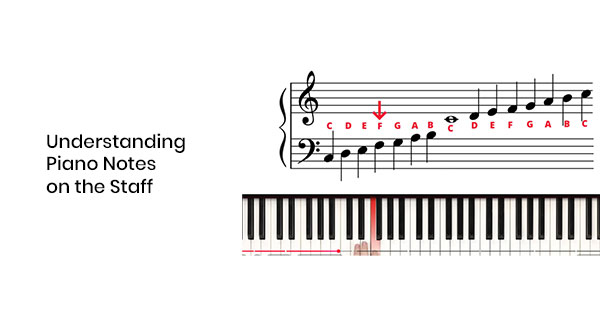
Learning to read music can feel overwhelming at first — but once you understand how notes on the staff connect to the keys on a piano, everything becomes much clearer. The image above is a perfect example of how musical notation translates directly to the keyboard. In this guide, we’ll break down what the diagram shows, how the treble and bass clefs work, and how to confidently find notes on the piano. Whether you’re a new pianist or refreshing your skills, this explanation will help you build a strong foundation.
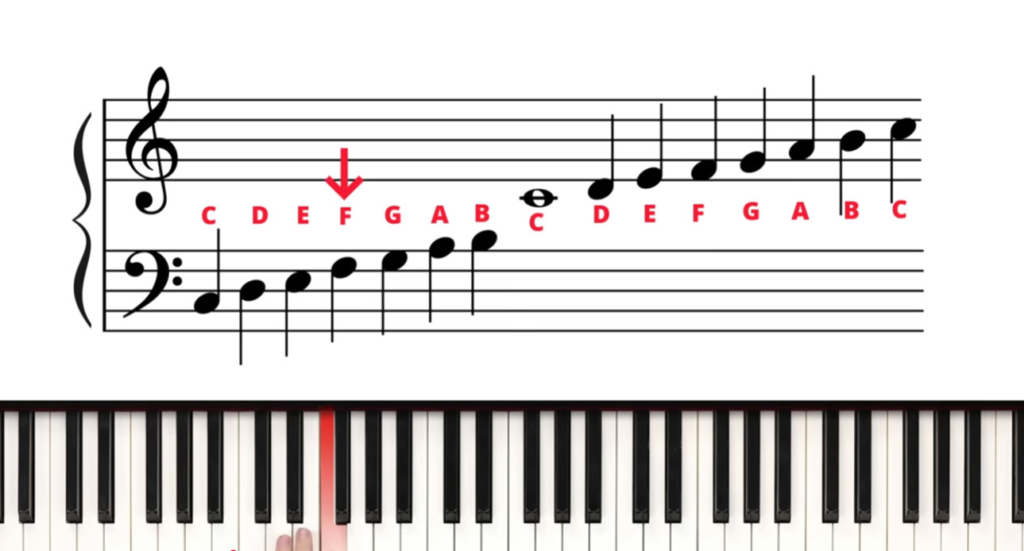
The visual demonstrates how the C major scale appears on both the treble clef and bass clef, and how each written note corresponds to a specific piano key.
Join our Piano Online Course with 37 Lessons, 60 Exercises, 72 PDFs, 32 Articles, 24 Quizzes, Multiple eBooks,
Treble and Bass Clefs
The staff is divided into two parts:
- Treble Clef (top staff):
Played with the right hand; represents higher-pitched notes. - Bass Clef (bottom staff):
Played with the left hand; represents lower-pitched notes.
Together, these form the grand staff, the standard notation system for piano music.
Step-by-Step Notes
The red letters under the notes label the ascending pitches:
- Bass Clef: C – D – E – F – G – A – B
- Treble Clef: C – D – E – F – G – A – B – C
This diagram essentially shows the C major scale climbing from low to high.
Highlighted Note
A red arrow points to the note F in the treble clef.
This helps beginners visually understand where the note sits on the staff and which key on the piano it matches.
Keyboard Match
At the bottom, the piano keyboard displays the corresponding key in red.
This demonstrates exactly where your finger goes for each note written on the staff — a key concept for early sight-reading practice.
How to Read These Notes on the Piano
✔ Memorize Landmark Notes
Anchor notes such as Middle C, Treble G, and Bass F help you quickly orient yourself on the staff.
✔ Understand Lines and Spaces
Every line and every space represents a unique pitch.
Moving upward on the staff means moving right/upward on the keyboard.
✔ Connect the Staff to the Keyboard
The piano repeats every 12 notes, but the staff shows them in linear order. This diagram bridges the two visually.
✔ Practice the C Major Scale
Because the C scale has no sharps or flats, it’s ideal for learning how notation works.
This type of diagram is incredibly helpful because it:
- Combines notation with real piano keys
- Builds instant recognition of notes
- Makes learning both clefs easier
- Helps beginners visualize the musical alphabet
- Reinforces proper hand placement and orientation
Mastering the relationship between staff notes and piano keys is one of the foundations of becoming a confident pianist.
Understanding how notes on the staff correspond to the piano keyboard is a major step in developing strong music-reading skills. The diagram above offers a clear, beginner-friendly demonstration of the C major scale across both clefs. By learning how each note is written and where it lives on the keyboard, you’ll build confidence, accuracy, and fluency at the piano. Keep practicing with visuals like this, and reading music will soon feel natural and intuitive.



Hi, this is a comment. To get started with moderating, editing, and deleting comments, please visit the Comments screen in…